
Building a Shareable Agentic AI for Marketing and Sales
A practical architecture, not a 'field of dreams'
The conversation we've been having around generative AI in marketing has largely focused on productivity. Teams experiment with prompts, generate campaign drafts, produce event copy, and accelerate content production. The speed is real. The problem is that most organizations quickly discover a second-order consequence: the faster content can be generated, the faster inconsistency spreads.
Field marketers begin writing their own prompts. Sales teams use their preferred tools. Messaging fragments across regions, products, and campaigns. Content appears that does not reflect the current positioning, product narrative, or brand voice. Eventually, the organization finds itself with two competing realities: an official marketing strategy on paper and a shadow marketing system powered by uncontrolled AI usage.
The answer is not restricting AI. The answer is building the right AI.
Organizations should build a shareable agentic AI system that operates inside a controlled knowledge environment. Instead of each employee improvising prompts in public models, the company provides a centralized agent that understands its positioning, product architecture, ICP definitions, messaging frameworks, and campaign structures. When implemented correctly, this agent becomes a marketing operating layer that accelerates content creation while maintaining strategic consistency.
This article outlines how to actually build that system.
The architecture of a marketing AI agent
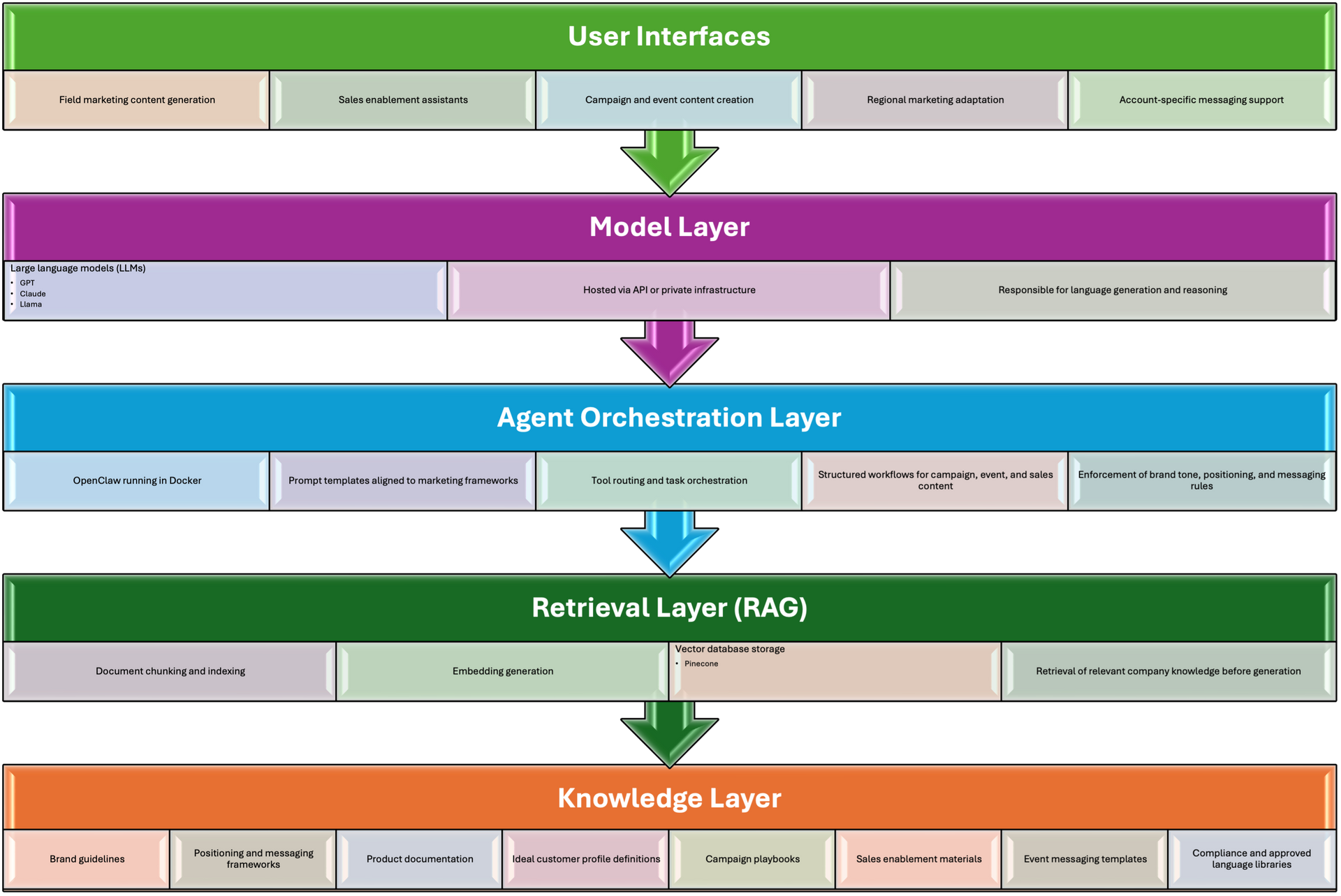
A shareable marketing agent is not simply a chatbot with a long prompt. It is an orchestrated system built around four layers.
Controlled knowledge layer
The first requirement is a curated knowledge corpus. This is the “walled garden” that prevents hallucination and messaging drift.
Typical inputs include:
- Brand guidelines
- Positioning and messaging frameworks
- Product documentation
- Customer segmentation and ICP definitions
- Sales enablement decks
- Event playbooks and campaign templates
- Compliance guidelines and legal language
- Past campaign assets and messaging libraries
These materials are indexed into a retrieval system so the agent answers questions using company-approved information rather than generating speculative responses.
This architecture mirrors the way AI-native platforms structure complex knowledge. For example, systems like CyberDD aggregate multiple signals and documents into a structured model that produces consistent outputs from fragmented inputs.
The same structural principle applies to marketing knowledge: consolidate sources, normalize them, and allow the agent to reason across them.
Technically, this layer is implemented with:
- vector databases
- retrieval augmented generation (RAG) pipelines
- document chunking and embedding
- citation and source verification
The result is an AI that references the organization’s own knowledge before generating any content.
The agentic layer
Once the knowledge layer is established, the next step is adding agent behavior.
Most generative AI systems simply produce text. An agentic system orchestrates tasks using structured logic.
For example, when a field marketer asks:
“Create promotion content for our cybersecurity webinar in London.”
The agent does not immediately produce copy. Instead, it performs several internal steps:
- Retrieves positioning language for the relevant product category
- Identifies the correct buyer persona
- Applies the organization’s tone and voice guidelines
- Generates assets for multiple channels (email, LinkedIn, landing page)
- Aligns messaging with approved campaign frameworks
In effect, the AI applies the organization’s marketing logic before producing output.
This is what transforms generative AI from a writing assistant into a marketing execution system.
Infrastructure for deploying the agent
There are several viable ways to deploy this architecture. A practical and secure approach is to run the agent in a controlled cloud environment.
A typical stack might include:
Compute Environment
AWS is a common choice because it provides flexible infrastructure for containerized workloads and secure access controls. Running the system inside AWS ensures the organization’s proprietary content does not leak into public models.
Agent Framework
An open agent framework allows orchestration of prompts, tools, and workflows.
OpenClaw running in Docker
OpenClaw can orchestrate multiple agents and tools while allowing deployment inside private infrastructure. Docker containers make the system portable and easy to scale across environments.
Retrieval System
A vector database such as Pinecone
This layer stores embeddings of company documents, enabling the agent to retrieve relevant information during generation.
Embedding Models
Embeddings convert documents into vector representations. Options include:
- OpenAI embeddings
- AWS Titan embeddings
- open-source models like BGE or Instructor
LLM Layer
Depending on security and cost requirements, the generation layer can run on:
- OpenAI GPT models
- Anthropic Claude via AWS Bedrock
- Llama or Mistral models hosted privately
Creating a shareable interface
A marketing agent only becomes valuable when it is accessible to the teams who need it.
This typically requires three user layers.
Field marketing interface
Allows regional marketers to generate:
- event promotion content
- regional campaign copy
- localized messaging
- social promotion assets
Because the agent uses the official knowledge corpus, the output remains aligned with the company narrative.
Sales interface
Sales teams can generate:
- personalized outreach
- follow-up emails after events
- account-specific messaging
- customer briefing summaries
The AI becomes a real-time sales enablement engine.
Marketing operations interface
Marketing leadership governs the system by updating:
- positioning frameworks
- campaign templates
- tone and voice guidelines
- product messaging
This shifts governance from reviewing every asset to managing the system that produces them.
Eliminating “Skunk Works” marketing
One of the biggest hidden problems with the adoption of generative AI is the rise of unofficial marketing workflows.
Field teams begin generating materials independently. Regional campaigns diverge from central messaging. Sales decks include unverified product claims. Eventually, brand and legal teams must intervene, slowing down execution.
A shareable agent solves this problem structurally.
When every team has access to high-quality AI that produces better outputs than ad hoc prompting, the incentive to create rogue workflows disappears. Instead of enforcing compliance manually, the organization encodes compliance into the system itself.
Agentic AI is a strategic asset
Marketing technology historically focused on customer data: CRM systems, marketing automation, analytics platforms.
Agentic AI introduces a new infrastructure layer: organizational knowledge execution.
Instead of storing customer information, the system stores marketing expertise. Positioning frameworks, messaging logic, and campaign playbooks become operational assets that the organization can deploy instantly.
This is particularly valuable for companies with complex products and distributed teams. Sales and marketing alignment, cross-channel campaigns, and personalized outreach all depend on consistent messaging across the organization.
When those principles are embedded into an AI agent, the organization gains both speed and consistency.
The ultimate win
Most discussions about AI in marketing focus on writing faster.
That is a small outcome.
The real opportunity is to build systems in which institutional knowledge becomes executable. When the marketing narrative, positioning frameworks, and campaign structures are encoded into an agent, every employee gains access to the organization's collective expertise.
The result is not just faster content creation. It is a marketing organization that scales its thinking, not just its output.